
Terrace vs Semi-Detached vs Detached Houses in Singapore Which Is Right for You?
Terrace, semi-detached and detached houses can differ substantially in privacy, land configuration, side access, frontage, layout flexibility and ongoing maintenance. The right choice depends on much more than simply buying the largest landed property your budget allows.
This guide compares the main landed housing types in Singapore and highlights the practical differences buyers should examine before deciding which type of landed home best fits their needs.
Last reviewed: 18 August 2026
Terrace vs Semi-Detached vs Detached: The Short Answer
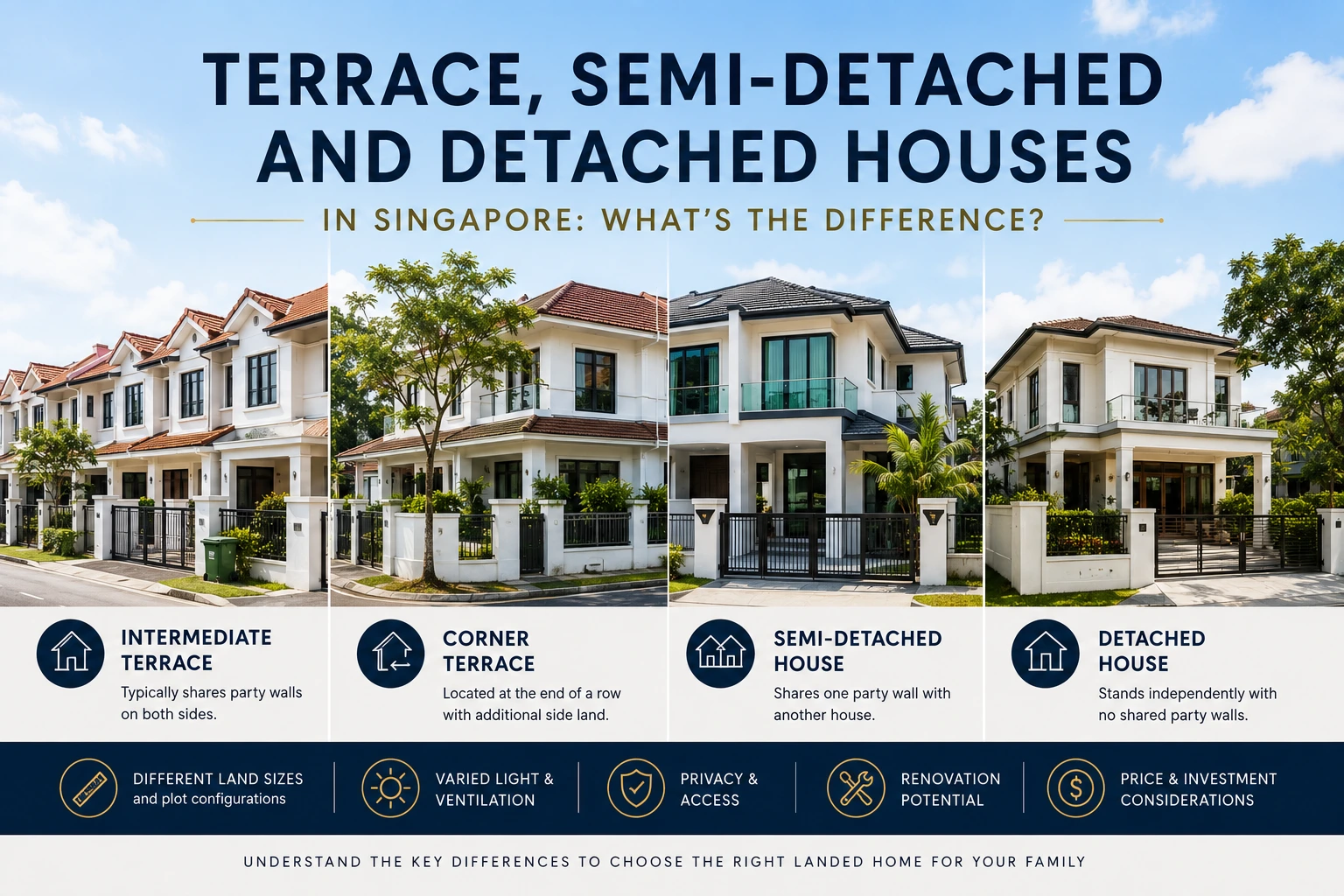
An intermediate terrace is typically attached to neighbouring terrace homes on both sides. A corner terrace sits at the end of a terrace row and may have additional open space along one side. A semi-detached house generally shares one party wall with an adjoining house, while a detached house generally stands independently.
However, house type alone does not determine which property is better. Buyers should compare the actual plot, frontage, orientation, internal layout, building condition, location, renovation requirements and long-term suitability of each home.
Quick Comparison
Terrace vs Semi-Detached vs Detached House
The table below provides a practical comparison. Actual properties can vary considerably even within the same classification.
| House Type | Typical Attachment | Side Space | Privacy | Key Buyer Consideration |
|---|---|---|---|---|
| Intermediate Terrace | Generally attached on both sides | Usually more limited | Depends heavily on layout and surroundings | Frontage, light, ventilation and internal width |
| Corner Terrace | Generally attached on one side within a terrace row | May provide additional side land | May offer greater separation on the open side | Usability of side land, road exposure and plot shape |
| Semi-Detached | Generally shares one party wall | Commonly provides open space on the other side | Often stronger separation than a terrace | Plot dimensions, access, orientation and layout |
| Detached | Generally no shared party wall | Separation around the building varies by site | Potentially greater privacy | Maintenance, land efficiency and total ownership cost |
Why Landed Property Classification Matters
Buyers often begin their landed-property search by deciding between a terrace house, semi-detached house or detached house. Classification is useful because it gives buyers an initial indication of how a property relates to neighbouring homes.
It should not, however, be used as a shortcut for determining quality or value. Two homes within the same category can differ substantially in frontage, depth, plot shape, side space, orientation, privacy, building condition and internal layout.
A corner terrace with useful side space may suit one household better than a semi-detached house with an inefficient layout. Likewise, a well-maintained intermediate terrace in the preferred neighbourhood may be more suitable than a larger house requiring extensive rebuilding.
At a Glance
Main Landed Housing Types in Singapore
Intermediate Terrace
An intermediate terrace house is generally positioned between neighbouring terrace homes and typically shares party walls on both sides.
Usually connected to neighbouring homes on both sides
Can provide an accessible route into landed ownership relative to larger landed formats
Natural light and cross-ventilation deserve careful assessment
Frontage and internal width can strongly influence the floor plan
Corner Terrace
A corner terrace generally sits at the end of a terrace row and may have additional open land along one side.
May provide useful additional side space
Can offer better opportunities for natural light
Road exposure, noise and privacy should be evaluated
Plot shape and side access can vary considerably
Semi-Detached House
A semi-detached house is generally paired with one adjoining house and usually shares a party wall on one side.
Typically shares one side with another house
May provide stronger side access and separation
Plot dimensions can differ significantly
Internal planning should still be assessed property by property
Detached House
A detached house generally stands independently without sharing a party wall with another home.
Usually offers greater separation from neighbouring homes
May provide more privacy and circulation space
Maintenance and renovation commitments can be greater
Plot efficiency remains important despite the larger housing format
Intermediate Terrace House: What Buyers Should Examine
Intermediate terrace houses are commonly considered by buyers who want landed ownership while keeping land requirements and ongoing maintenance more manageable than some larger landed formats.
The quality of an intermediate terrace often depends heavily on frontage, internal width, floor-plan efficiency and the way natural light reaches the centre of the home.
Frontage and Internal Width
Frontage can influence room proportions, staircase placement, car-porch use and how open the interior feels. Two terrace homes with similar land areas can therefore provide very different living experiences.
Light and Ventilation
Because an intermediate terrace is attached on both sides, buyers may wish to examine courtyards, air wells, rear openings and other sources of daylight and ventilation.
Agent W perspective: An intermediate terrace should not automatically be treated as an inferior landed option. A practical layout, desirable street, manageable renovation requirement and suitable location may matter more to a household than simply owning a larger property type.
Corner Terrace House: Is the Extra Side Land Worth It?
Corner terrace houses often attract buyers who value additional side space, greater separation from one neighbouring property or the possibility of improved natural light.
The important question is not simply whether side land exists, but whether it is genuinely useful. Width, shape, access, orientation and surrounding road conditions can materially affect how valuable the additional space is to the household.
Additional Side Land
Side space may support landscaping, circulation or greater separation, subject to the property's actual configuration.
Natural Light
An exposed side elevation may provide additional opportunities for daylight depending on the existing design.
Road Exposure
Some corner plots may experience additional traffic, noise or reduced privacy because of their road position.
Plot Shape
A larger land area is not automatically more usable. Regularity and practical configuration matter.
Semi-Detached House: Privacy Without Going Fully Detached
Semi-detached homes may appeal to buyers who want greater separation and side access while retaining a more efficient land configuration than some detached properties.
Buyers should still evaluate the property's actual orientation, frontage, side space, building age, internal planning and renovation requirements rather than assuming that every semi-detached house provides the same experience.
Greater Separation
Open space along one side may improve accessibility, daylight, ventilation and separation from neighbouring buildings, depending on the particular site.
Layout Still Matters
Staircase position, bedroom sizes, circulation, orientation and future renovation flexibility can be more important to day-to-day living than classification alone.
Detached House: Maximum Separation, but More to Evaluate
Detached houses generally provide the greatest separation from neighbouring homes and can appeal to buyers looking for privacy, flexibility and outdoor space.
The trade-off is that larger properties can also involve more extensive maintenance, renovation planning and ongoing ownership commitments. Buyers should therefore evaluate the entire ownership proposition rather than treating detached status as an automatic indication of superiority.
Privacy
Greater physical separation may improve privacy, although surrounding buildings and site conditions still matter.
Outdoor Space
Some detached homes provide larger gardens, circulation areas or recreational space.
Maintenance
A larger building envelope and outdoor areas can increase maintenance and long-term budgeting requirements.
Buyer Framework
How to Choose Between a Terrace, Semi-Detached and Detached House
Instead of asking which landed type is objectively best, compare how each actual property supports your household's needs, financial plans and long-term intentions.
1. Start With Location
A larger house in the wrong location may be less suitable than a smaller landed home closer to schools, family, work or amenities that matter to you.
2. Determine Your Real Space Requirement
Consider bedrooms, multigenerational living, work-from-home requirements, parking and outdoor use before deciding how much house and land you actually need.
3. Examine the Plot
Frontage, depth, shape, orientation and side space can affect usability and future possibilities more than headline land area alone.
4. Review the Existing Building
A property's condition and configuration can materially affect the budget required after purchase.
5. Consider Maintenance
More land and a larger building can create greater ongoing maintenance responsibilities.
6. Think About Your Exit Strategy
Consider whether the property is likely to remain suitable if your household needs change and how easily future buyers may understand its appeal.
Investment Perspective
Which Landed House Type Is Better for Investment?
Buyers considering landed property as part of a longer-term wealth or investment strategy should avoid assuming that the largest housing type automatically offers the strongest investment characteristics.
Entry price, land characteristics, location, tenure, condition, future buyer demand and the amount of capital required after purchase can all influence the overall proposition.
Read the Singapore Landed Property Investment GuideCommon Landed Property Misconceptions
Bigger Doesn't Always Mean Better
More land or a larger house does not automatically provide a better living experience. Layout efficiency, location, orientation, renovation requirements and household needs can matter more.
Every Corner Terrace Is Different
Side land, road frontage and usable outdoor space vary considerably. Buyers should inspect actual site conditions instead of relying solely on the corner-terrace label.
A Semi-Detached House Isn't Automatically More Practical
The classification may provide additional separation, but poor internal planning, an unsuitable orientation or major renovation requirements can still affect suitability.
Renovation Potential Depends on More Than House Type
Planning considerations, structural design, building condition, approved plans and the actual site may influence renovation possibilities. Buyers should assess the specific property carefully.
Frequently Asked Questions
What is the difference between a terrace, semi-detached and detached house in Singapore?
A terrace house generally forms part of a row of landed homes. A semi-detached house is typically paired with one adjoining house, while a detached house generally stands independently. Buyers should also compare the actual plot, frontage, layout, condition and surroundings of each property.
Is a detached house always better than a semi-detached house?
Not necessarily. The most suitable property depends on lifestyle needs, budget, location, plot characteristics, layout, maintenance expectations and long-term plans.
Is a corner terrace better than an intermediate terrace?
A corner terrace may provide additional side space, natural light and greater separation from one neighbour, but its usefulness depends on plot shape, road exposure, privacy, access and the actual configuration of the property.
Are all corner terrace houses significantly larger?
No. Corner terrace houses vary considerably in land size, usable side space, frontage and layout. Buyers should evaluate the actual site rather than relying on the classification.
Should I buy a terrace, semi-detached or detached house?
The decision should reflect your household's space requirements, preferred location, budget, privacy needs, renovation plans, maintenance expectations and longer-term property strategy.
Does landed house type affect financing?
Financing depends on multiple factors including the specific property, valuation, buyer profile and prevailing lending requirements. Buyers should confirm financing arrangements with their lender before committing to a purchase.
Continue Learning
More Singapore Landed Property Guides
Landed Property Buying Guide Singapore
Understand the broader financial, tenure and practical considerations involved in buying a landed home.
Read GuideLanded Property Investment Singapore
Examine landed property from an investment perspective, including entry price, location, tenure and longer-term considerations.
Read GuideFreehold vs Leasehold Landed Property
Compare landed-property tenure and the factors buyers should consider when evaluating freehold and leasehold homes.
Read GuideHow to Choose a Landed Property
Review the practical considerations buyers can evaluate when comparing individual landed homes.
Read GuideContinue Your Landed Property Journey
Next recommended reads in Landed Property Guides.
You May Also Find These Guides Useful
Recommendations from related property categories.
Property Planning Tools
Use these calculators and financial tools to understand the numbers behind your property decision.
Comparing Terrace, Semi-Detached or Detached Homes?
The classification tells only part of the story. Plot shape, frontage, orientation, building condition, location, renovation requirements and long-term plans can materially affect which landed property is more suitable.
If you are comparing actual landed properties, I can help you structure the comparison around the factors that matter before you make a commitment.
Discuss Your Landed Property Options