
Ramp-Up Factory vs Flatted Factory Singapore: Which Is Better For Your Business?
Choosing between a ramp-up factory and a flatted factory is about more than building design. Vehicle accessibility, operational workflow, logistics efficiency and future business expansion should all be considered before making a decision.
The Short Answer
Neither ramp-up factories nor flatted factories are universally better. The right choice depends on your business operations, delivery requirements, workflow, vehicle access and long-term operational objectives.
Businesses with frequent deliveries or heavier logistics may value the convenience of direct vehicle access, while others may place greater importance on efficient production layouts, accessibility or overall operating costs.
Understanding how each building type supports your business is often more important than focusing solely on the property's age or appearance.
Understanding The Two Factory Types
Singapore's industrial market offers a variety of factory configurations. Two of the most common are ramp-up factories and flatted factories. While both support industrial activities, their layouts and operational advantages can differ significantly.
Selecting the right configuration should start with understanding how your staff, suppliers, vehicles and production workflow interact with the premises every day.
Vehicle Access
Consider how deliveries and vehicle movement affect your daily operations.
Production Workflow
Internal layout should support efficient movement of people, materials and finished products.
Future Growth
Choose premises that can continue supporting your business as operational requirements evolve.
Who Should Read This Guide?
Manufacturing businesses
Food factory operators
Warehouse users
Importers and distributors
SMEs relocating to larger premises
Business owners comparing industrial developments
Companies planning long-term ownership
Investors evaluating industrial properties
What Is A Ramp-Up Factory?
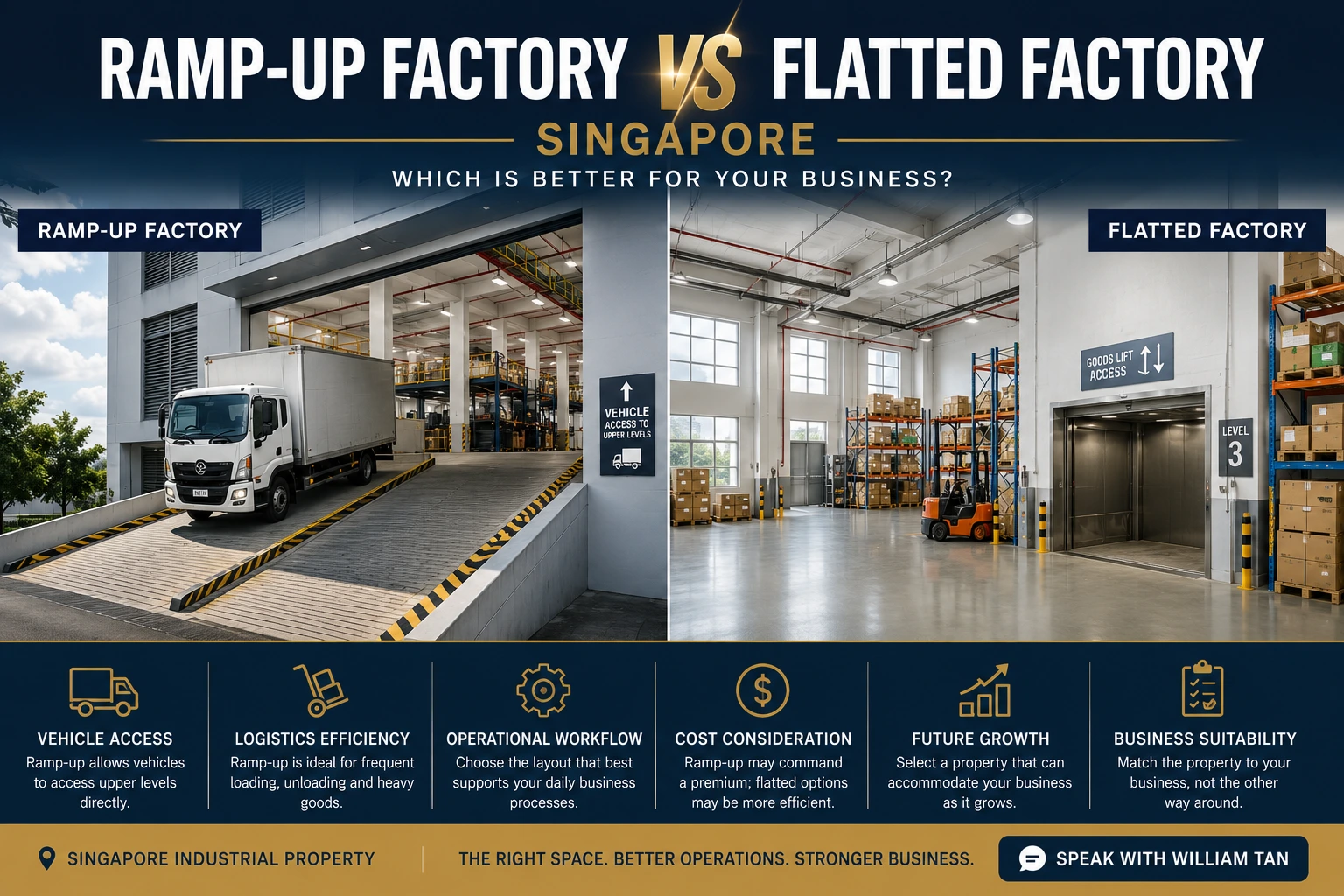
A ramp-up factory is typically designed with vehicle ramps that allow selected vehicles to access upper levels directly. This can be useful for businesses that rely heavily on loading, unloading, movement of goods or frequent deliveries.
Ramp-Up Factories May Suit Businesses That:
Require frequent loading and unloading.
Handle bulky goods or heavier inventory.
Need easier vehicle access to the unit.
Operate warehousing or distribution activities.
Prefer direct logistical convenience.
Need efficient movement between vehicle and premises.
What Is A Flatted Factory?
A flatted factory is a multi-storey industrial building where access to upper-floor units is usually supported by common lifts, cargo lifts, loading areas and shared building facilities. These properties can suit businesses that do not require direct vehicle access to the unit itself.
Flatted Factories May Suit Businesses That:
Have lighter production or storage needs.
Do not require vehicles to access the unit directly.
Can operate efficiently with cargo lift access.
Prioritise functional work space over direct ramp access.
Need suitable premises at a more manageable cost.
Operate with predictable delivery schedules.
Ramp-Up vs Flatted Factory: Key Differences
The better option depends on how your business handles goods, deliveries, staff movement and daily workflow.
| Consideration | Ramp-Up Factory | Flatted Factory |
|---|---|---|
| Vehicle Access | May allow selected vehicles to access upper levels more directly. | Usually relies on loading bays, cargo lifts and shared access routes. |
| Logistics Convenience | Often preferred by businesses with frequent movement of goods. | Can be suitable where goods movement is lighter or well scheduled. |
| Operational Fit | Useful where direct access improves daily workflow. | Useful where production or storage does not require direct vehicle access. |
| Cost Consideration | May command a premium where direct access is valued. | May offer more manageable entry or rental options in some cases. |
| Business Suitability | Often considered by warehousing, logistics and heavier goods users. | Often considered by lighter industrial, production or storage users. |
What To Check During A Viewing
The right factory type should be evaluated during an actual viewing, not only from floor plans or listing photos. Pay close attention to how your business would move goods, staff and equipment through the property.
Can vehicles access the loading areas efficiently?
Are cargo lifts suitable for your goods and equipment?
Is the turning radius practical for your delivery vehicles?
Will loading and unloading create delays?
Does the layout support your production or storage workflow?
Is there enough space for future operational growth?
Are shared facilities likely to affect daily efficiency?
Does the property suit your staff, suppliers and customers?
Common Mistakes When Choosing Between Ramp-Up And Flatted Factories
Choosing Based Only On Price
A lower price may not be worthwhile if the factory layout creates delivery delays, workflow issues or operational inconvenience.
Ignoring Vehicle Access
For businesses with frequent deliveries, vehicle access can directly affect daily productivity and manpower efficiency.
Assuming Ramp-Up Is Always Better
Ramp-up access is useful for some businesses, but not every company needs direct vehicle access to the unit.
William Tan's Perspective
When comparing ramp-up and flatted factories, I usually advise business owners to focus on their daily operations first. The most suitable property is not always the newest or most impressive-looking building, but the one that allows the business to operate efficiently.
For some companies, direct vehicle access can save time and manpower. For others, a well-planned flatted factory with good cargo lift access and efficient layout may be more than sufficient. The key is to match the property to the business, not the other way around.
Featured Industrial Projects
Comparing different industrial developments can help you assess which building type and layout better supports your business operations.
Space18
Explore a freehold industrial development suitable for selected businesses evaluating long-term ownership.
Explore ProjectSpace Nova
Compare another modern industrial development when reviewing layout, accessibility and ownership options.
Explore ProjectGourmet Xchange
A food factory development that may be relevant for selected food-related businesses.
Explore ProjectUseful Property Tools
Financial Tools
Explore calculators and planning resources for your next industrial property decision.
ExploreStamp Duty Calculator
Estimate acquisition costs before purchasing an industrial property.
CalculateIndustrial Property Guides
Continue exploring industrial property topics before making your next business property decision.
Read GuidesContinue Your Industrial Journey
Next recommended reads in Industrial Guides.
You May Also Find These Guides Useful
Recommendations from related property categories.
Property Planning Tools
Use these calculators and financial tools to understand the numbers behind your property decision.
Comparing Ramp-Up And Flatted Factories?
Every business has different loading, storage, production and accessibility requirements. Choosing the right industrial property starts with understanding how the building supports your daily operations.
Speak With William