
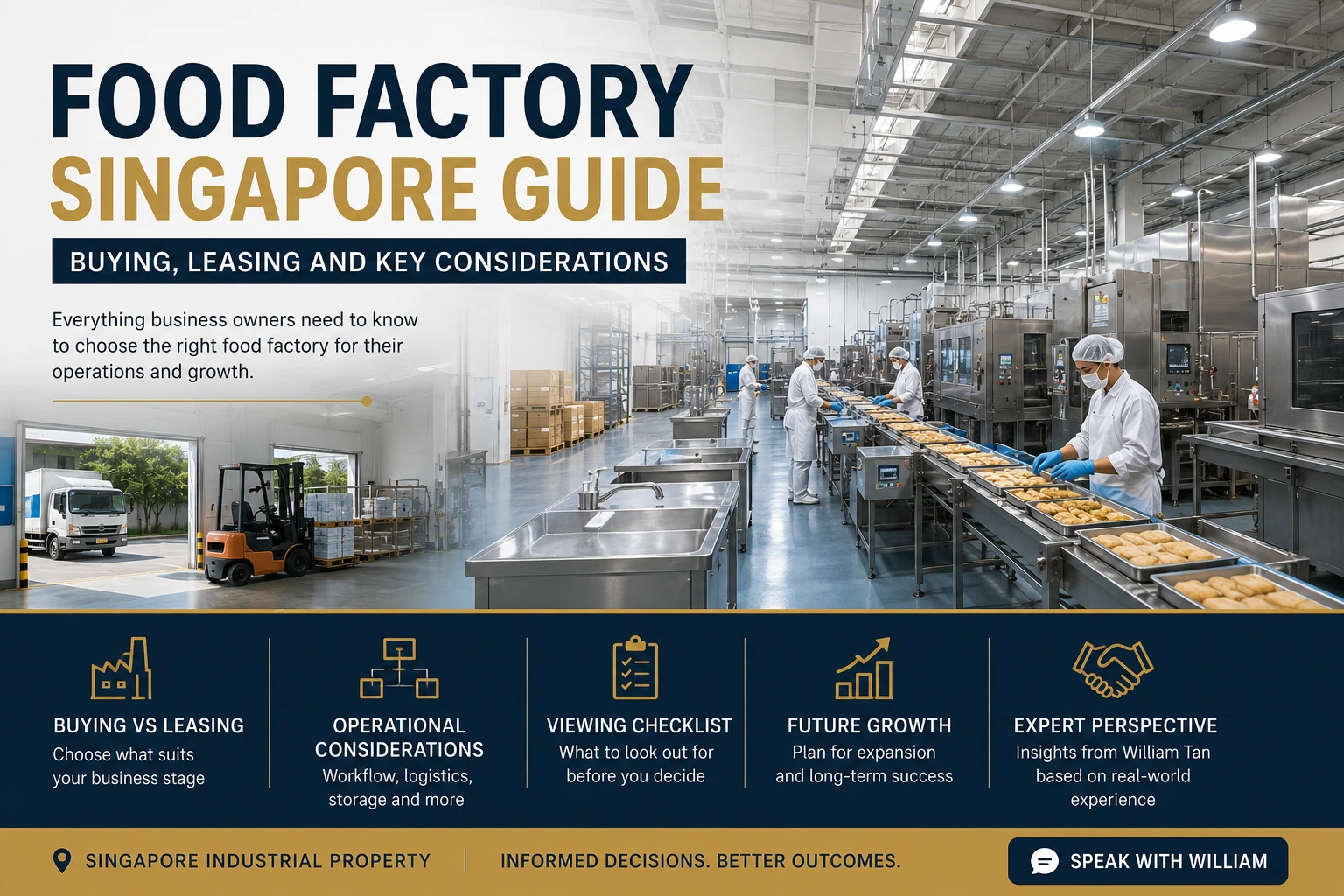
Food Factory Singapore Guide: Buying, Leasing and Key Considerations
Selecting the right food factory involves more than finding available space. Business workflow, logistics, operational efficiency and long-term expansion plans should all be considered before deciding whether to buy or lease a food factory in Singapore.
The Short Answer
The best food factory is not necessarily the newest or the largest. It should support your production workflow, logistics, staffing requirements and future business growth while remaining financially sustainable over the long term.
Whether you are establishing your first production facility or expanding into a larger premises, selecting the right industrial property requires balancing operational requirements with business objectives.
Understanding the practical considerations before making a decision can help reduce costly renovations, operational disruptions and future relocation needs.
What Is A Food Factory?
Food factories are industrial premises designed for businesses involved in food production, preparation, processing, packaging and related operations. Depending on the business model, the space may also accommodate storage, distribution and administrative functions.
Every food business operates differently, which means there is no single factory layout that suits everyone. The right premises should support your operational workflow rather than forcing your business to adapt around the building.
Production
The production area should accommodate your operational process efficiently while allowing room for future growth.
Logistics
Loading access, vehicle movement and delivery efficiency can significantly influence daily operations.
Workflow
The internal layout should support smooth movement between preparation, production, storage and dispatch activities.
Which Businesses Typically Need A Food Factory?
Food factories are used by a wide range of businesses. While operational requirements differ, most companies require premises that support efficient production, storage and distribution.
Food manufacturers
Central kitchens
Food processors
Frozen food businesses
Beverage producers
Food importers and distributors
Bakery production facilities
Catering preparation facilities
Buying vs Leasing A Food Factory
The right choice depends on your business stage, cash flow, expansion plans and how long you expect to operate from the same premises.
| Consideration | Leasing May Suit | Buying May Suit |
|---|---|---|
| Business Stage | Businesses still testing production volume or market demand. | Established operators with stable production requirements. |
| Capital Planning | Preserves cash for operations, equipment and manpower. | May build long-term property ownership if financing is manageable. |
| Expansion Flexibility | Easier to relocate if space requirements change. | More suitable when the unit can support future growth. |
| Fit-Out Investment | Consider lease term before spending heavily on renovation. | Ownership may justify longer-term fit-out planning. |
Key Operational Considerations Before Choosing A Food Factory
Food factory users should think beyond unit size. A space that looks large on paper may still be unsuitable if the layout, access, workflow or building specifications do not support daily production.
Production Workflow
Consider how ingredients, staff, equipment, finished goods and deliveries move through the premises. A poor layout can create inefficiencies even if the unit size appears sufficient.
Loading And Delivery Access
Loading access, vehicle circulation and delivery timing are important for food operators handling raw materials, packaging supplies or finished products.
Storage And Cold Room Planning
Businesses dealing with chilled or frozen products should consider whether the premises can support storage needs, equipment placement and future expansion requirements.
Office And Administrative Space
Some food businesses also require space for administration, sales support, quality control, meetings or staff facilities. These areas should be planned together with production space.
Food Factory Viewing Checklist
Before committing to a food factory, use the viewing to assess whether the premises can realistically support your business. The following checklist can help guide your inspection.
Does the layout support your production workflow?
Is loading access suitable for deliveries and dispatch?
Can the premises support your storage requirements?
Is there sufficient space for equipment and future expansion?
Are staff movement and operational zones practical?
Can renovation and fit-out requirements be accommodated?
Is the location suitable for suppliers, staff and customers?
Does the property support your intended business use?
Common Mistakes When Choosing A Food Factory
Choosing Based Only On Floor Area
A larger unit does not automatically result in better operations. Layout, workflow and accessibility are often more important than overall square footage.
Underestimating Future Growth
Selecting a unit that only meets today's production needs may result in an expensive relocation if the business expands sooner than expected.
Ignoring Operational Efficiency
Daily operations such as receiving goods, production, packaging and dispatch should flow efficiently through the premises to minimise unnecessary movement and downtime.
William Tan's Perspective
Having assisted businesses searching for food factories, one of the most common observations is that companies often focus on rental or purchase price first. While pricing is important, the property's operational suitability usually has a much greater impact on long-term business efficiency.
I generally encourage business owners to visualise their entire workflow before making a decision. Thinking about production, storage, deliveries, staff movement and future expansion at the viewing stage can help avoid costly compromises later.
Featured Food Factory Opportunities
Explore industrial developments that may suit food-related businesses looking for owner-occupation or investment opportunities.
Gourmet Xchange
Modern food factory development designed for qualifying food-related businesses seeking ownership opportunities.
Explore ProjectSpace18
Freehold industrial development suitable for selected businesses requiring long-term ownership.
Explore ProjectSpace Nova
Compare another modern industrial development while evaluating your long-term business requirements.
Explore ProjectUseful Property Tools
Continue Your Industrial Journey
Next recommended reads in Industrial Guides.
You May Also Find These Guides Useful
Recommendations from related property categories.
Property Planning Tools
Use these calculators and financial tools to understand the numbers behind your property decision.
Looking For The Right Food Factory?
Every food business has unique operational requirements. Choosing the right premises starts with understanding how the property supports your workflow, growth plans and long-term business objectives.
Speak With William