
Commercial Property Guide
Grade A vs Grade B Office Buildings Explained
Compare location, rental cost, building quality, tenant profile and practical business considerations before choosing Grade A or Grade B office space in Singapore.
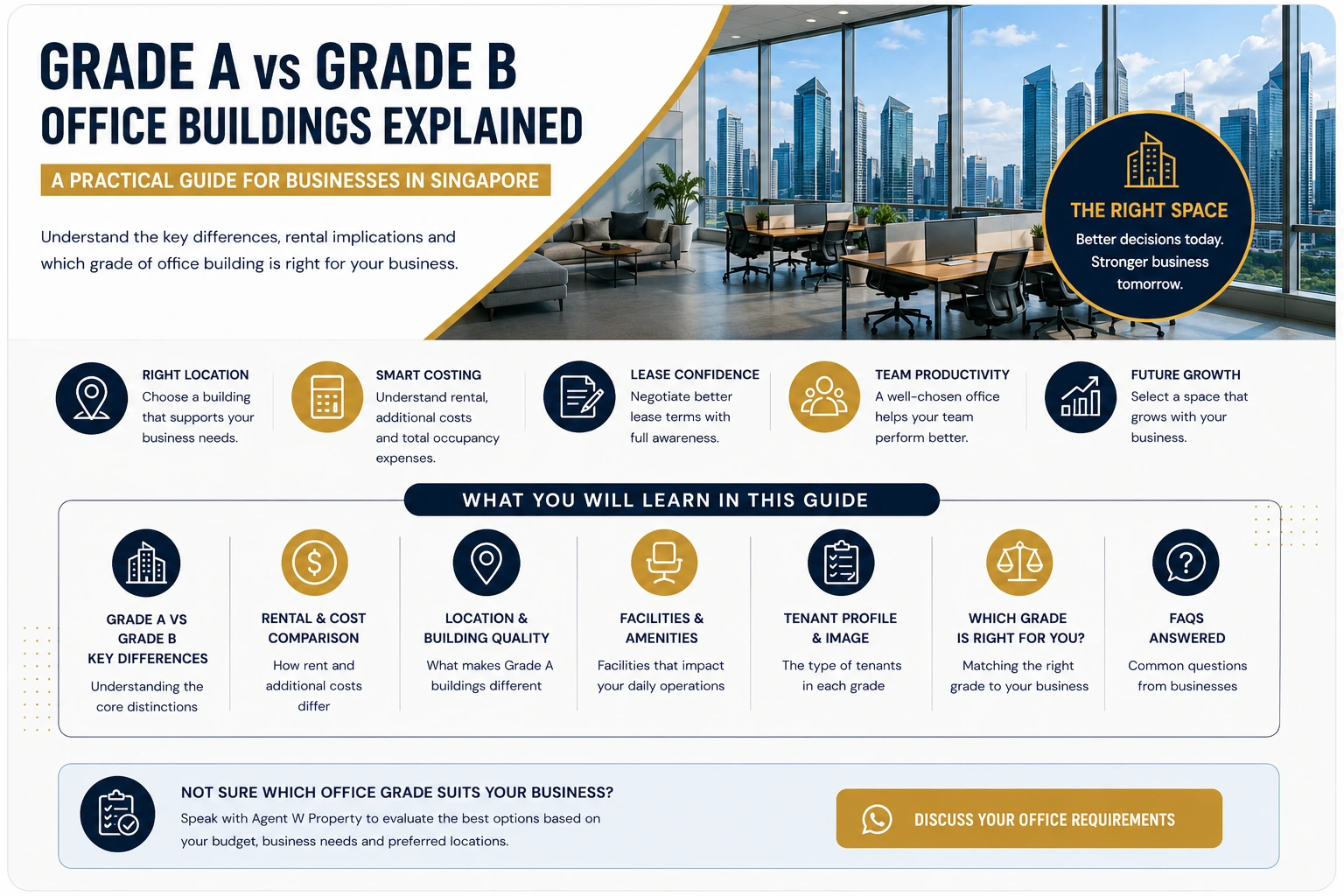
Understand what Grade A and Grade B office classifications generally mean
Compare location, rental cost, specifications and tenant profile
Assess total occupancy cost instead of rent alone
Choose an office grade based on how your business actually operates
Businesses comparing office space in Singapore frequently encounter terms such as Grade A office, Grade B office, premium office and prime CBD office. These classifications help describe differences in building quality, location, specifications, management and market positioning.
However, office grades should not be treated as absolute labels. There is no single factor that automatically makes one building suitable for every company. A Grade A office may support corporate image and client-facing requirements, while a well-located Grade B office may provide considerably stronger cost efficiency.
The more useful question is therefore not simply whether Grade A is better than Grade B, but which office provides the right combination of location, specifications, image, staff convenience and total occupancy cost for your business.
Grade A vs Grade B Office Singapore: The Quick Answer
Grade A offices generally represent the more premium end of the office market, with stronger building specifications, professional management, prominent locations and higher rental expectations.
Grade B offices are generally positioned below this premium segment and may be older, more practically specified or located outside the most prestigious office clusters. Many remain professionally managed, highly accessible and entirely suitable for established businesses.
The right choice depends on whether your business benefits enough from the additional location, image and building quality of Grade A space to justify the higher overall occupancy cost.
What Does Grade A Office Mean in Singapore?
Grade A is generally a market classification used to describe higher-quality office buildings rather than a single statutory government grade applied uniformly to every commercial property.
Buildings commonly regarded as Grade A may combine a prime business location with modern specifications, prominent frontage, professional building management, quality common areas, efficient lift systems and a strong corporate tenant profile.
In Singapore, many offices positioned within the Grade A segment are found in established business districts such as Raffles Place, Marina Bay, Tanjong Pagar and the wider Downtown Core. However, the characteristics of the individual building remain more important than the label alone.
What Does Grade B Office Mean in Singapore?
Grade B office buildings generally sit below the premium Grade A segment in terms of market positioning, specifications, age, location or overall presentation.
This does not mean that a Grade B building is poor quality. Many provide efficient floor plates, professional management, strong MRT accessibility and practical facilities at significantly more manageable rental levels.
Grade B offices can therefore be particularly relevant for SMEs, professional-services firms, trading businesses, back-office teams and companies where operational efficiency matters more than occupying the most prestigious address.
Grade A vs Grade B Office: Main Differences
The distinction goes far beyond rental price. Businesses should compare the complete building and occupancy proposition before deciding which grade provides better value.
| Factor | Grade A | Grade B |
|---|---|---|
| Location | Often prime CBD or major business locations | Can include CBD and fringe locations |
| Rental | Generally higher | Generally more cost-efficient |
| Building Presentation | Typically stronger lobby and common-area presentation | More variable depending on building age and management |
| Building Specifications | Often newer or higher specification | Often more practical and building-specific |
| Tenant Profile | Common among larger corporations and premium occupiers | Broad mix of SMEs and established businesses |
| Best Fit | Image-sensitive and client-facing businesses | Businesses prioritising value and operational efficiency |
Location: Does Your Business Need a Prime CBD Address?
Location can be one of the strongest reasons for paying a premium for Grade A office space. A recognised business address may be valuable to firms that regularly host clients, investors or overseas business partners.
However, a prestigious address should still be evaluated against how employees and clients actually travel to the office. MRT connectivity, sheltered access, nearby food options, parking and the distance from key customers can sometimes matter more than the office grade itself.
Office Rental: Compare Total Occupancy Cost, Not Rent Alone
Grade A offices generally command higher rents, but headline rent should not be the only financial comparison.
Businesses should also examine service charges where applicable, fit-out requirements, reinstatement obligations, utilities, parking, moving costs and the amount of space required to accommodate the same number of employees.
A more efficient Grade A floor plate can sometimes reduce the amount of space required. Conversely, a lower-rent Grade B office may allow a company to secure a substantially larger premises within the same overall budget.
Building Specifications and Employee Experience
Building specifications can affect employees every working day. Lift waiting times, air-conditioning hours, ceiling height, natural light, floor-plate efficiency, washrooms, accessibility and surrounding amenities may all influence the experience of occupying the office.
Companies should therefore inspect the actual building rather than assuming that every Grade A building offers the same standard or that every Grade B building provides a materially weaker working environment.
Corporate Image and Client-Facing Requirements
Businesses in sectors such as finance, professional services, wealth management and corporate advisory may place greater value on building image because clients regularly visit the office.
For businesses where clients rarely visit, paying a substantial premium for lobby appearance or address prestige may provide less operational benefit.
The decision should therefore reflect the role the physical office plays in supporting the company's brand rather than a belief that a higher office grade is automatically superior.
Which Businesses May Prefer Grade A Office Space?
Grade A space may be particularly relevant where the office forms an important part of the company's corporate presentation.
Examples can include businesses that frequently receive clients, require a prominent Singapore address, compete heavily for professional talent or want their premises to align with an international corporate identity.
Which Businesses May Prefer Grade B Office Space?
Grade B can be attractive where cost efficiency, floor-area requirements and practical accessibility are more important than premium building positioning.
Businesses with larger operational teams, limited client traffic or stricter occupancy budgets may find that a good Grade B building provides substantially stronger value without materially affecting day-to-day operations.
Which Office Grade Is Right for Your Business?
There is no universal answer. The correct office grade depends on how the premises support the business rather than which building carries the more prestigious market label.
Before signing a lease, consider your total occupancy budget, staff commuting patterns, client profile, space requirements, lease duration, expected headcount growth and the image you want the office to project.
Once these requirements are clear, comparing actual buildings becomes more useful than deciding in advance that your company must occupy either Grade A or Grade B space.
Grade A and Grade B Are Market Classifications
Office grades are useful market descriptions, but buyers and tenants should not assume that every building is classified identically by every market participant.
Compare the actual building, unit, lease terms and operating requirements rather than relying on the grade label alone.
Do Not Choose Based on Grade Alone
A well-managed Grade B office beside an MRT station may be more suitable than a Grade A office that stretches the company's budget or creates inconvenience for employees. The correct choice depends on the business model, team, customers and expected occupancy period.
Rental Cost Is Only One Part of the Decision
Compare total occupancy cost, including the amount of space required, fit-out, possible service charges, utilities, parking, reinstatement obligations and other lease-related expenditure.
Questions to Ask Before Choosing
- • How frequently do clients visit the office?
- • Does our business genuinely benefit from address prestige?
- • What total occupancy cost can we comfortably sustain?
- • How important is daily MRT convenience for employees?
- • Will our headcount change during the lease?
- • Do we require extended air-conditioning hours?
- • How much fit-out work will the premises require?
- • Could we obtain more efficient space in another building?
Common Characteristics of Grade A Offices
- Often located in prime CBD or established business districts
- Strong lobby and common-area presentation
- Modern or higher building specifications
- Professional building management
- Corporate tenant profile
- Generally higher rental expectations
- May support client-facing and brand-sensitive businesses
- Often positioned toward premium office occupiers
Common Characteristics of Grade B Offices
- Generally more cost-efficient rental levels
- May include older buildings or non-prime locations
- Practical and functional office layouts
- Can still provide strong MRT accessibility
- Suitable for SMEs and operational teams
- Potential to secure more space within the same budget
- Building quality varies significantly by property
- May offer strong value where prestige is not the main priority
What to Compare During an Office Viewing
- Walking distance and sheltered route from the MRT
- Lobby and arrival experience
- Lift capacity and waiting time
- Floor plate and usable office layout
- Natural light and views
- Air-conditioning arrangement and operating hours
- Parking and loading accessibility
- Nearby food and employee amenities
- Existing fit-out and reinstatement requirements
- Potential expansion space within the building
Frequently Asked Questions
Comparing Grade A and Grade B Offices?
The difference between two office options may extend far beyond rent. Location, floor efficiency, building image, lease terms, accessibility and fit-out requirements can materially affect the overall decision.
Agent W Property can help you compare actual Singapore office options based on your business requirements and total occupancy considerations.
Continue Your Commercial Journey
Next recommended reads in Commercial Guides.
You May Also Find These Guides Useful
Recommendations from related property categories.
Property Planning Tools
Use these calculators and financial tools to understand the numbers behind your property decision.
About the Author
This article was written by William Tan, founder of Agent W Property. William advises homeowners and investors across Singapore on HDB upgrading, property wealth planning, private residential purchases, commercial property and industrial real estate strategies.
Learn more about William Tan