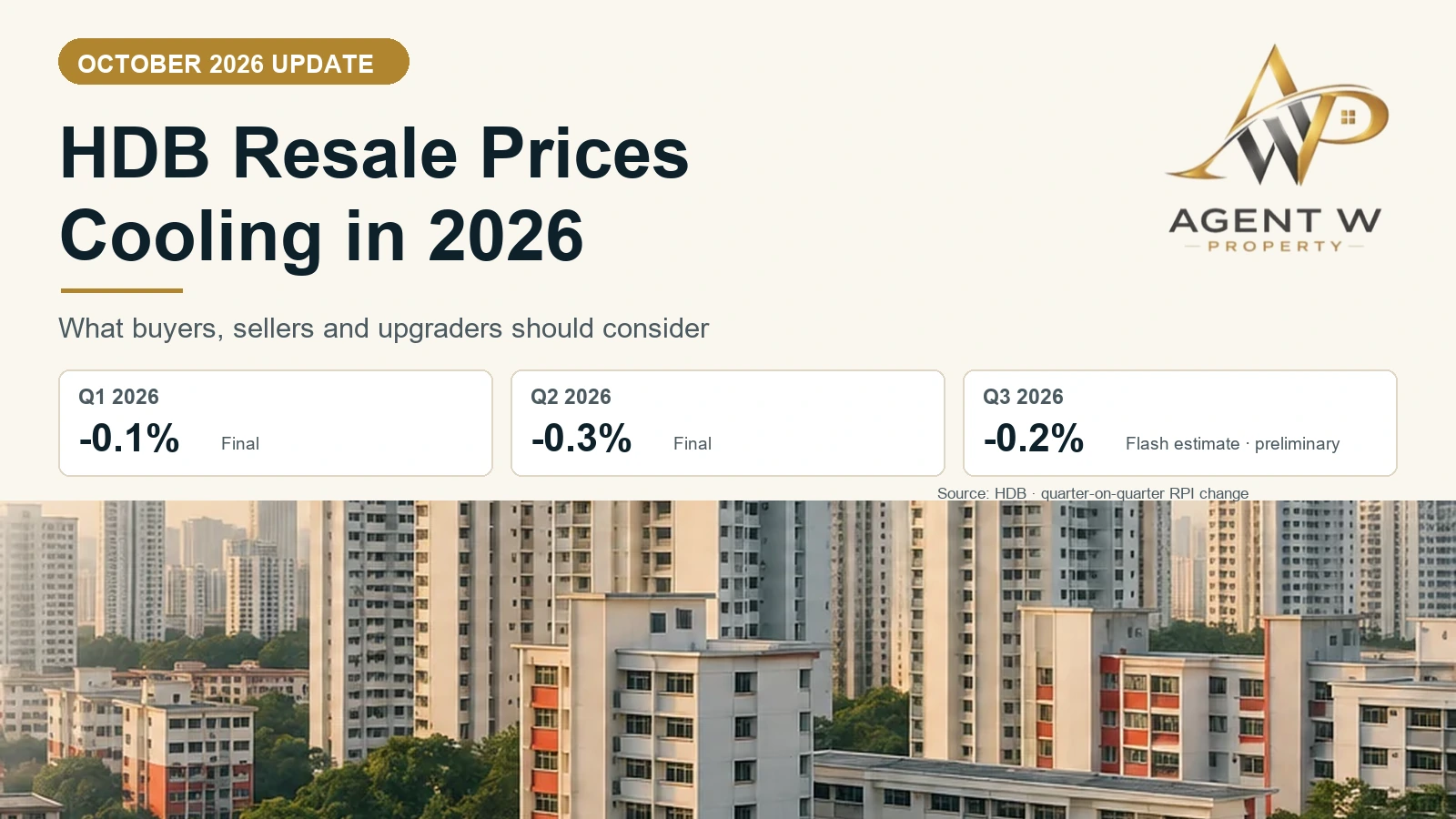
Singapore’s HDB resale market continues to show signs of moderation. Two confirmed quarterly price declines in the first half of 2026 have been followed by a preliminary decline in the third quarter.
For homeowners and buyers, the useful question is how these conditions affect the specific flat, budget and housing move you are considering.
The latest HDB resale figures
| Period | HDB Resale Price Index | Quarterly change | Status |
|---|---|---|---|
| Q1 2026 | 203.4 | −0.1% | Final |
| Q2 2026 | 202.8 | −0.3% | Final |
| Q3 2026 | 202.4 | −0.2% | Flash estimate; preliminary |
The Q1 decline was the first since Q2 2019. HDB’s Q3 flash estimate points to a third consecutive quarterly decline, although that estimate may be revised.
Sources: HDB Q1 release, HDB Q2 release, HDB Q3 flash estimate.
Resale activity has continued. As of 29 September, HDB recorded 7,528 Q3 transactions, compared with 7,157 over the same period in 2025—an increase of 5.2%. These are figures at the stated cut-off, rather than final full-quarter totals. HDB Q3 flash estimate.
Agent W’s takeaway
My reading is that the published figures suggest moderation. They do not establish that every flat is becoming cheaper or that a larger correction will follow.
A national index cannot tell you the appropriate price for a particular home. Town, flat type, remaining lease, floor level, condition and nearby alternatives still matter.
What could influence the market?
The following considerations are Agent W’s analysis, rather than proven explanations for the quarterly declines.
Housing alternatives. New-flat options may influence whether eligible households buy resale now or wait. Their relevance depends on eligibility, location and the household’s timeline.
Affordability. Buyers should assess the total commitment: purchase price, financing, cash and CPF requirements, renovation and a comfortable financial buffer.
Seller expectations. When price momentum softens, sellers may need to give greater weight to comparable completed transactions and competing homes.
These factors can interact differently across neighbourhoods. A modest change in the national index does not imply identical negotiating conditions everywhere.
Does this mean HDB resale prices will crash?
The available figures do not support that conclusion.
Small quarterly declines should be read alongside transaction activity and the characteristics of the individual flat. They also cannot establish where prices will move next.
Before making a decision, compare recent transactions involving similar flats, paying attention to:
- The block and surrounding neighbourhood.
- Flat type, size and remaining lease.
- Floor level, orientation and condition.
- Access to transport and amenities.
- Competing homes and renovation requirements.
What should HDB sellers consider?
Start with evidence for your own flat.
A national decline is not a reason to automatically cut your asking price. Equally, a record transaction elsewhere may be a poor benchmark if the flat differs substantially from yours.
A practical selling plan should combine a defensible asking price, realistic net proceeds and the cost of your next housing move. If viewings or offers are weaker than expected, reassess the presentation and comparable alternatives before deciding whether to adjust the price.
What should HDB buyers consider?
A moderating market may create room to negotiate in some cases, but that should be assessed unit by unit.
Set a comfortable budget before viewing. Compare completed transactions, consider renovation costs and check how the remaining lease fits your plans.
Waiting solely for a larger price decline can also create uncertainty. Your housing needs and financial position should carry more weight than an attempt to identify the market’s lowest point.
How do the recent policy changes fit in?
The 15-month wait-out restriction was removed for qualifying private homeowners buying a non-subsidised resale flat without an HDB loan. Buyers still need an HFE letter; private residential properties must be disposed of within six months of resale completion. The separate 30-month requirement remains for subsidised purchases, developer EC purchases and HDB loans. HDB policy release.
HDB’s Q3 release reports no significant increase in prices or purchases by private owners and former owners since the removal. An assumed demand surge should therefore not be treated as an observed result. HDB Q3 flash estimate.
For eligible HFE applications from 24 August, family ceilings rose from $14,000 to $16,000 for subsidised flats, resale purchases with the CPF Housing Grant and HDB loans. Eligible singles aged 35 and above have an $8,000 ceiling, up from $7,000. The $18,000 new-EC ceiling, previously $16,000, applies to qualifying sites with tender closing dates on or after 24 August—not every available EC. HDB income-ceiling announcement.
These changes can widen options for eligible households. Their effect on resale demand remains something to observe.
Read more: 15-month wait-out update · HDB and EC income ceilings.
What about upgrading from HDB to a condominium?
Assess the sale and purchase together.
Your HDB selling price is only one part of the decision. Compare realistic sale proceeds with the full cost of the intended condominium, financing commitments, transaction expenses and any temporary accommodation.
A slightly lower sale price may still fit a workable upgrade plan. A strong sale price may still leave the next purchase uncomfortable.
The useful measure is whether the complete move suits your household and leaves sufficient financial flexibility.
Should you sell now or wait?
Selling may deserve consideration when your home no longer suits your needs, your next housing plan is clear and the finances are comfortable.
Waiting may be appropriate when the next purchase would stretch your budget, your housing requirements are uncertain or a move would create unnecessary costs.
Neither choice should depend on the headline index alone.
Official Sources
Frequently asked questions
Are HDB resale prices falling in 2026?
The table above shows two final quarterly declines and a preliminary third-quarter decline.
Does a lower index mean my flat is worth less?
It does not establish your flat’s value. Comparable transactions and the flat’s attributes remain essential.
Is this a good time to buy?
That depends on the particular home, your affordability and your housing timeline.
Should owners sell before prices fall further?
Further declines are uncertain. Assess your reason for selling and the complete next-home plan.
Do the policy changes guarantee stronger resale demand?
They do not. Eligibility changes create options; actual effects must be assessed through market evidence.
Understand your position before your next move
Whether you are buying, selling, right-sizing or upgrading, start with your own numbers.
Agent W Property can help you compare recent transactions, your estimated selling position and the finances involved in your next property move.
Discuss your property plans with Agent WThis article provides general information. National statistics do not determine the value or future performance of an individual flat. Confirm current eligibility and financing requirements before committing to a transaction.