
B1 vs B2 Industrial Property Singapore: What's The Difference?
Choosing between a B1 and B2 industrial property is one of the first decisions many business owners face when buying or leasing industrial space in Singapore. Understanding the differences helps ensure that the property aligns with your operational requirements, future growth plans and intended business activities.
The Short Answer
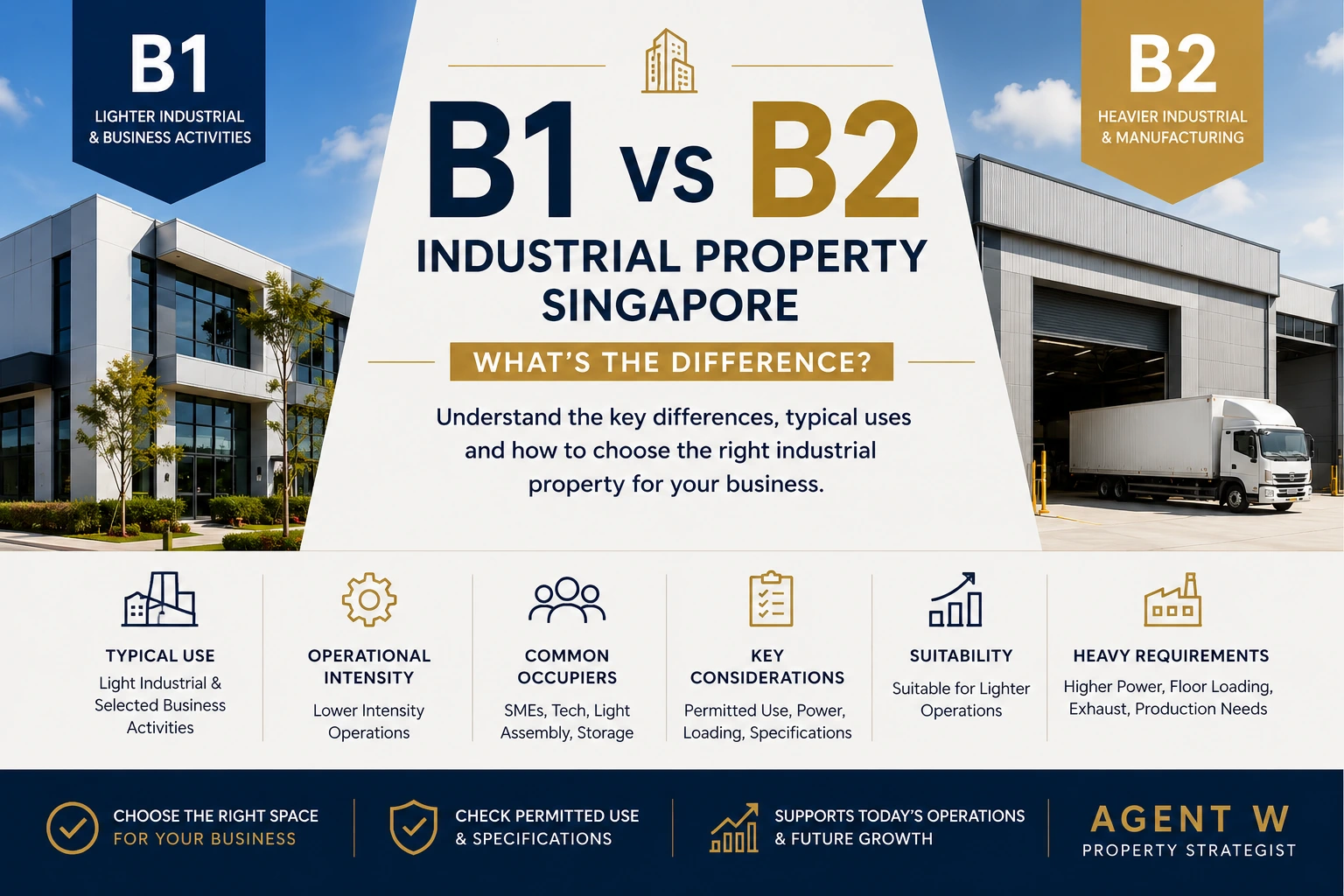
In simple terms, B1 industrial properties are generally intended for lighter industrial and business activities, while B2 industrial properties are generally intended for heavier industrial uses. The most suitable option depends on your business operations, equipment requirements, production processes and the property's permitted use.
Many buyers assume that choosing between B1 and B2 is simply a matter of selecting the cheaper property. In reality, the more important question is whether the industrial space supports your day-to-day operations while remaining suitable for your future business growth.
Before committing to any purchase or lease, business owners should consider operational requirements such as loading facilities, electrical capacity, ceiling height, floor loading, vehicle access and whether the property's permitted use aligns with the intended business activity.
Who Should Read This Guide?
Business owners purchasing their first industrial property.
Companies relocating to a larger industrial facility.
Investors comparing different industrial property types.
SMEs looking to understand industrial zoning before making a property decision.
Understanding Industrial Zoning In Singapore
Industrial developments in Singapore are planned to support different types of business activities. Rather than viewing B1 and B2 as better or worse than one another, it is more helpful to see them as categories designed to accommodate different operational requirements.
Selecting the appropriate industrial property is therefore not just a property decision. It is also an operational decision that can affect workflow, staff movement, logistics, future expansion and overall business efficiency.
B1 Properties
Generally intended for lighter industrial activities and selected business operations.
B2 Properties
Generally intended for businesses with heavier industrial or manufacturing requirements.
Choosing Correctly
The most suitable property depends on your intended business activity and operational requirements rather than price alone.
B1 vs B2 Industrial Property: Key Differences
The table below gives a practical overview. Actual suitability should still be checked based on the property's specific approval, specifications and your intended business use.
| Comparison Point | B1 Industrial | B2 Industrial |
|---|---|---|
| Typical Use | Light industrial, clean production, selected storage and business support activities. | Heavier industrial, manufacturing, engineering, production and more intensive operational uses. |
| Operational Intensity | Generally lower intensity with less noise, smell, vibration or heavy machinery. | Generally higher intensity with more robust industrial requirements. |
| Common Occupiers | SMEs, technology firms, light assembly, e-commerce support, medical devices and selected storage users. | Manufacturers, engineering companies, food production operators, workshops and heavier production users. |
| Key Checks | Permitted use, loading access, power needs, office ratio and business activity suitability. | Permitted use, power supply, floor loading, exhaust, production requirements and regulatory approvals. |
| Buyer Consideration | Suitable if your business needs cleaner, lighter and more flexible industrial space. | Suitable if your business has heavier operational or production requirements. |
What Is B1 Industrial Property?
B1 industrial property is generally associated with lighter industrial uses and selected business activities. These spaces may appeal to companies that need a functional industrial setting without the heavier requirements of manufacturing or intensive production.
However, business owners should avoid assuming that every B1 industrial property is suitable for every light industrial use. The building's specifications, approved use, management rules and practical layout still need to be assessed carefully.
Businesses That May Consider B1
Light assembly or clean production
Technology-related operations
E-commerce fulfilment support
Medical device or precision-related businesses
Selected storage and distribution uses
Back-end business operations
What Is B2 Industrial Property?
B2 industrial property is generally associated with heavier industrial activities. These may include manufacturing, engineering, food production, workshops and businesses that require more robust operational specifications.
For B2 users, practical specifications often become more important than appearance. Items such as electrical loading, floor loading, exhaust requirements, drainage, loading access and vehicle circulation can directly affect whether the unit is suitable.
Businesses That May Consider B2
Manufacturing and production
Engineering and fabrication
Food production or central kitchen use
Workshops and heavier trade operations
Machinery-based businesses
Businesses requiring more robust industrial specifications
Common Misconceptions About B1 And B2 Industrial Property
Misconception 1: B2 Is Always Better Than B1
Not necessarily. B2 may allow for heavier industrial uses, but that does not mean it is the right choice for every business. If your operations are clean, light and office-support based, a suitable B1 property may be more practical.
Misconception 2: All Industrial Units Can Be Used For Any Business
This is one of the most costly assumptions business owners can make. Zoning, approved use, management rules, licensing and building specifications all matter. Buyers should verify suitability before committing.
Misconception 3: Price Is The Most Important Factor
Price matters, but the wrong property can become expensive if it causes operational delays, failed licensing, renovation restrictions or future relocation needs.
William Tan's Perspective
Many buyers spend significant time comparing price per square foot but not enough time checking whether the property's zoning and specifications match their actual business operations. In my experience, asking the right operational questions early helps filter unsuitable options quickly and prevents wasted viewings or costly commitments.
How To Decide Between B1 And B2 Industrial Property
The best way to decide is to start from your business operations, not from the property listing. A suitable industrial property should support your permitted use, workflow, staff movement, loading needs, equipment requirements and future expansion plans.
Practical Checklist Before Viewing
What is your intended business activity?
Do you require heavy machinery or production equipment?
Do you need exhaust, drainage or cold-room capability?
What power supply and floor loading do you need?
Do you need container access or loading bays?
Will the property still support your business in 3 to 5 years?
If your business operations are clean, light and relatively flexible, B1 may be sufficient. If your business involves heavier production, engineering, food preparation or more intensive industrial activity, B2 may be more relevant. However, each property should still be assessed individually.
Featured Industrial Projects To Explore
If you are comparing B1, B2 or food factory options, these projects may be worth reviewing depending on your business use, budget and operational requirements.
Space18
A freehold B1 industrial development that may suit selected businesses and long-term industrial property buyers.
View projectSpace Nova
A modern freehold industrial project that may appeal to buyers comparing city-fringe industrial ownership options.
View projectGourmet Xchange
A food factory development that may be relevant for selected food operators evaluating purpose-built production space.
View projectAlways verify zoning, specifications, approved use, availability and suitability before making a property decision.
Useful Property Tools
Before shortlisting an industrial property, estimate your stamp duty, rental yield and overall affordability.
Stamp Duty Calculator
Estimate buyer's stamp duty before purchasing an industrial property.
View toolRental Yield Calculator
Estimate potential rental yield if you are evaluating an investment property.
View toolFinancial Tools
Explore more calculators and planning tools for property decision-making.
View toolRelated Industrial Guides
Continue learning about industrial property before making your next business property decision.
Unsure Whether B1 Or B2 Is Right For Your Business?
Choosing the right industrial property involves more than comparing prices. William Tan can help you assess whether a property aligns with your intended use, operational needs, budget and long-term business plans.
Speak With William